Transkribus, from your own code
The Transkribus API runs the same AI as the Transkribus app: Text Titan, 300+ public models, Smart Extract, and every model you train yourself. Send a page image, get back text, layout and structured data.
Scholar plan and above · API jobs at half the credits of the app · Processed on our own servers in Austria
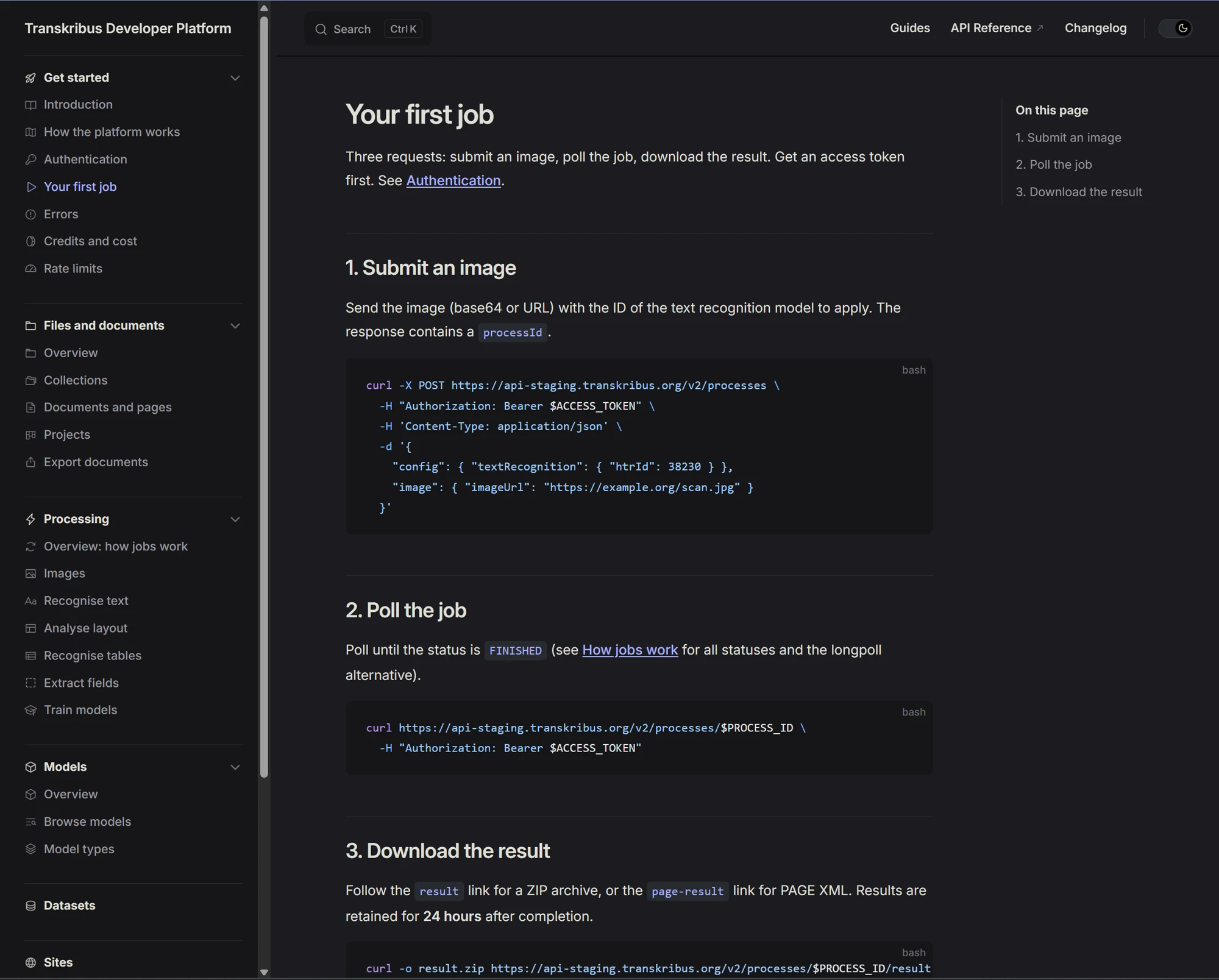
curl -X POST https://api.transkribus.org/v2/processes \
  -H "Authorization: Bearer $ACCESS_TOKEN" \
  -H "Content-Type: application/json" \
  -d '{
    "config": { "textRecognition": { "htrId": 38230 } },
    "image": { "imageUrl": "https://example.org/scan.jpg" }
  }'
Get a token. Then three requests.
Sign in with your Transkribus account, submit a page, poll the job, download the result. Every job type follows the same contract.
Authenticate
Exchange your Transkribus credentials for an access token via OpenID Connect.
POST /openid-connect/tokenSubmit a page
Send one image as base64 or URL, with the ID of the model to run.
POST /v2/processesPoll the job
Poll on an interval, or long-poll and get an answer the moment the status changes.
GET /v2/processes/longpoll/{id}Download the result
Take the JSON from the job, or fetch PAGE XML, ALTO XML or a ZIP archive.
GET /v2/processes/{id}/pageIncluded from the Scholar plan
The Transkribus API comes with every plan from Scholar upwards. You sign in with your Transkribus account, and API jobs use credits from your plan at half the rate of the same job in the app.
Scholar
For individual researchers: one seat, Text Titan II and the advanced AI tools, plus API access.
Team
Five seats and a shared credit pool for your team, plus API access.
Organisation
15+ seats, a dedicated success manager and custom onboarding, plus API access.
One API, two ways to read a page
Pick the job type in the request. Polling, results and errors work the same for both.
Text recognition
Turn printed and handwritten pages into text with full layout: regions, baselines, lines and reading order. Start with Text Titan, our super model for mixed print, cursive and Kurrent, or pick one of 300+ public models for a specific script, language or century. Models you train in Transkribus are addressed exactly the same way.
{
  "config": {
    "textRecognition": { "htrId": 38230 }
  },
  "image": {
    "imageUrl": "https://example.org/scan.jpg"
  }
}
Growing into the full Transkribus API
Text recognition and Smart Extract are live. The other capabilities of the Transkribus app follow one by one, and each new surface is announced in the developer changelog.
Live: Text recognition
Print and handwriting with layout, using super models, public models or your own.
Live: Smart Extract
Structured data from a page image in one job: text, tables, entities and page classes.
Live: JSON, PAGE XML, ALTO
Results straight from the job, in the format your systems already read.
Next: Layout, tables, fields
Layout analysis, table recognition and field models as jobs of their own.
Next: Model training
Train a model from your ground truth and use it by ID, all from code.
Next: Documents, export, Sites
Collections and documents, exports in every format, and publishing to Transkribus Sites.
The Transkribus advantage
Train in the app. Run it through the API.

Developer documentation
Everything else is at docs.transkribus.org
Case study
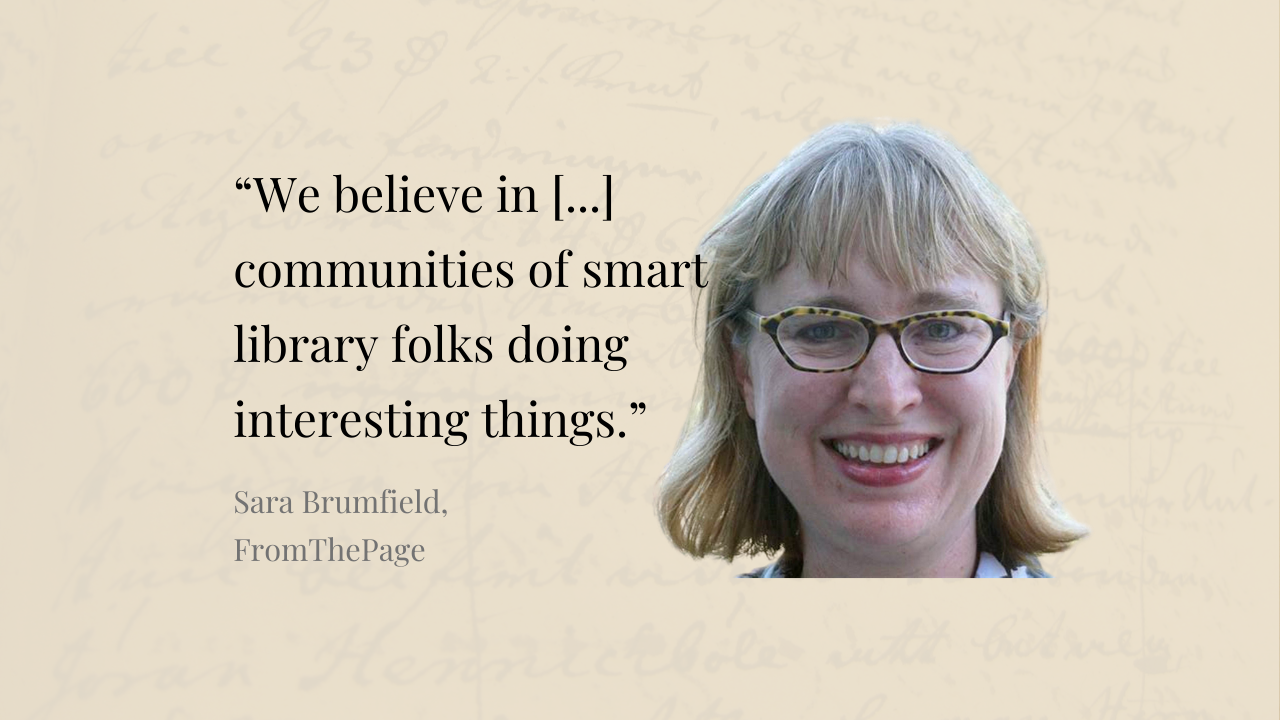
FromThePage: AI-assisted crowdsourcing via API
Try it yourself
Upload a document, printed or handwritten, and see the API response in real time.
Transkribus API: frequently asked questions
Start building with the Transkribus API
Get a Scholar plan or above, request a token and send your first page. For volume workloads and custom terms, talk to our team.