How to run a volunteer transcription project

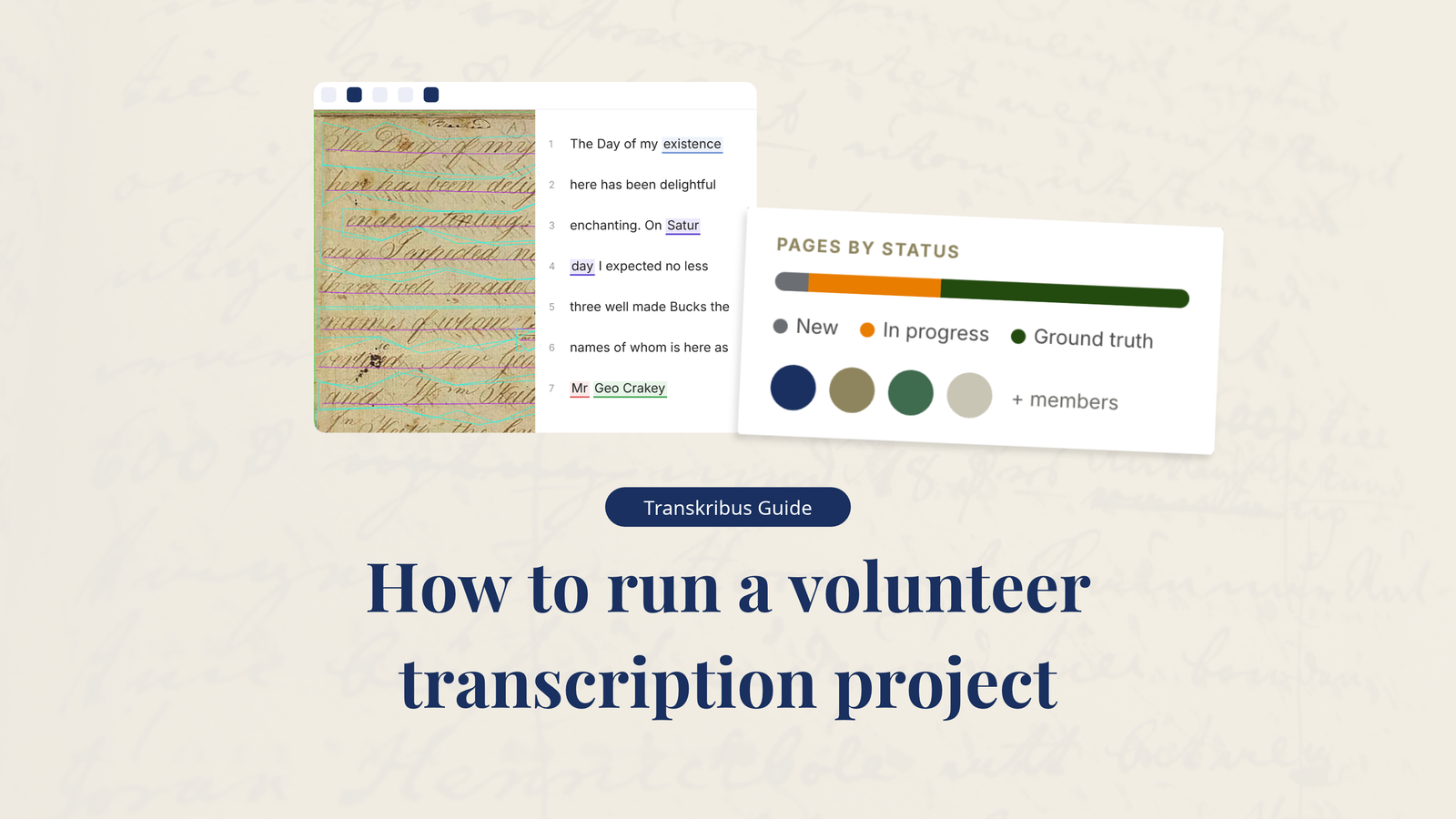
Every archive has them: registers, letters, wills and minutes that people ask for every week, but that nobody can search, because nobody has had the time to transcribe them. Staff numbers rarely match the size of the holdings.
Volunteers can change that. They bring a love of history, often a good deal of local knowledge, and the time to turn unreadable pages into searchable text. And with AI producing the first draft, volunteer projects now reach a scale that once seemed impossible: the Material Culture of Wills project is transcribing around 25,000 historical wills with more than 2,500 volunteers. On a smaller scale, the Museum Plantin-Moretus in Antwerp has built a close-knit community of around 50 volunteers around its UNESCO-listed archive.
This guide explains what volunteer transcription projects are, why institutions run them, and how to plan one that people want to join.
Crowdsourced transcription and citizen science in archives
A volunteer transcription project invites members of the public to turn historical documents into readable, searchable text. Volunteers transcribe or correct pages, check names and dates, or tag people and places. The institution provides documents, guidance and tools; the volunteers bring time, attention and often local or family knowledge.
These projects are a form of citizen science: research in which the public takes an active part. In the humanities, that often means documents. Genealogists index parish registers, local historians transcribe council minutes, and enthusiasts read letters no one has opened for a century.
The idea is old. What has changed is how much volunteers can achieve, and how many people can take part.
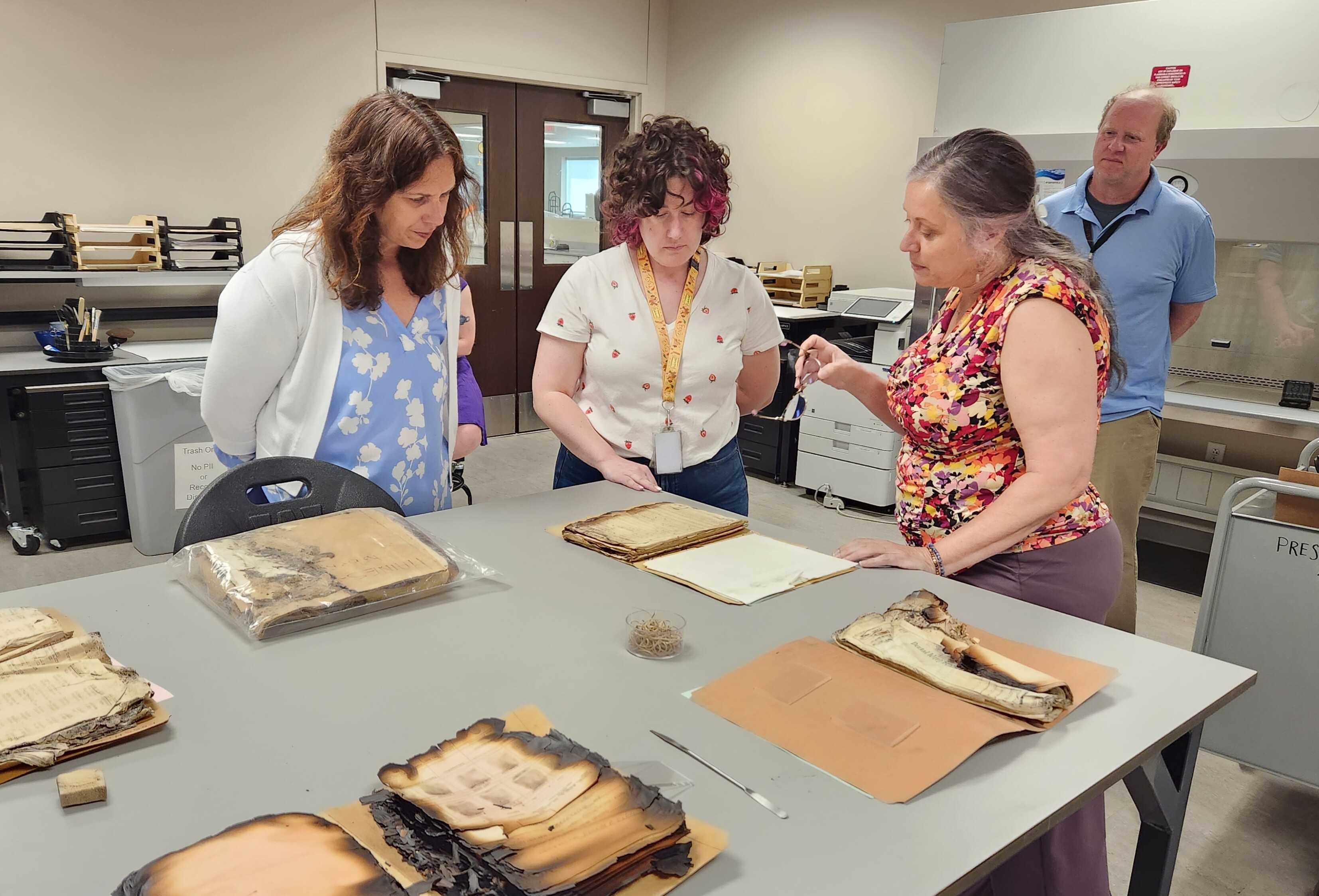
Archivists and preservation staff examine damaged records. Digitisation and transcription help keep fragile documents accessible. © archivesnews, via Wikimedia Commons

Why archives and libraries work with volunteers
Institutions start volunteer projects for many reasons, but three come up again and again.
- Scale. Many collections are far too large for the staff who look after them. Volunteers make it possible to open up material that would otherwise stay closed.
- Knowledge. A volunteer who grew up in a village recognises its family names. A genealogist knows which abbreviations a parish clerk liked to use. That knowledge improves a transcription in ways no budget could buy.
- Community. People who spend their evenings with a collection come to care about it. They tell others, write about what they find and come back for the next project.
For the Museum Plantin-Moretus in Antwerp, the third reason is the decisive one. Speaking at the Transkribus User Conference 2026, Kristof Selleslach, Curator of Archives at the Museum Plantin-Moretus, explained:
"For the cultural heritage sector, alongside research and providing access to sources, there's another important core function, and this is participation. […] We understand actively involving communities in decisions, activities and care related to cultural heritage, and that is why Museum Plantin-Moretus in Antwerp embarked on Transkribus as a citizen science project."
Volunteers gain something too: they learn a historical script, contribute to research and find stories that matter to them.
AI-assisted transcription: from typing to correcting
For a long time, volunteer transcription meant typing every page from scratch, which limited projects to people who could already read old handwriting and kept progress slow.
With automated handwritten text recognition (HTR), volunteers no longer start from a blank page. A specialised model produces a first draft, and volunteers correct it with the original image right beside it. That is faster and far more accessible: even someone who could never read a 17th-century hand alone can spot a wrong letter, and over time many learn to read the script themselves.
Each round of volunteer corrections becomes new training data and improves the model.
The corrections also feed back into the technology, because every corrected page can be used to train a better model. In the Material Culture of Wills project, run by the University of Exeter and The National Archives (UK), the first model, trained on around 30 pages, had a character error rate of about 11 %. After retraining on volunteer-corrected lines, it is now below 4 %.
Dr Emily Vine, Research Fellow on the Material Culture of Wills project, highlights:
"A project of our scale wouldn't be possible without [Transkribus], and this is why it hasn't been attempted until now."
Not every collection needs its own model, as the Museum Plantin-Moretus shows. Its archive, inscribed on UNESCO's Memory of the World register, mixes hundreds of hands and often several languages on a single page. Training a model for each hand would be virtually impossible, so the museum runs Transkribus Super Models and lets its volunteers correct the remaining errors. Even as AI improves, Selleslach reminds, "let's not forget the humans in all this transcription process."
How to plan a volunteer transcription project
Planning comes down to seven decisions. Each step below covers the essentials, with links to our Help Center for the details.
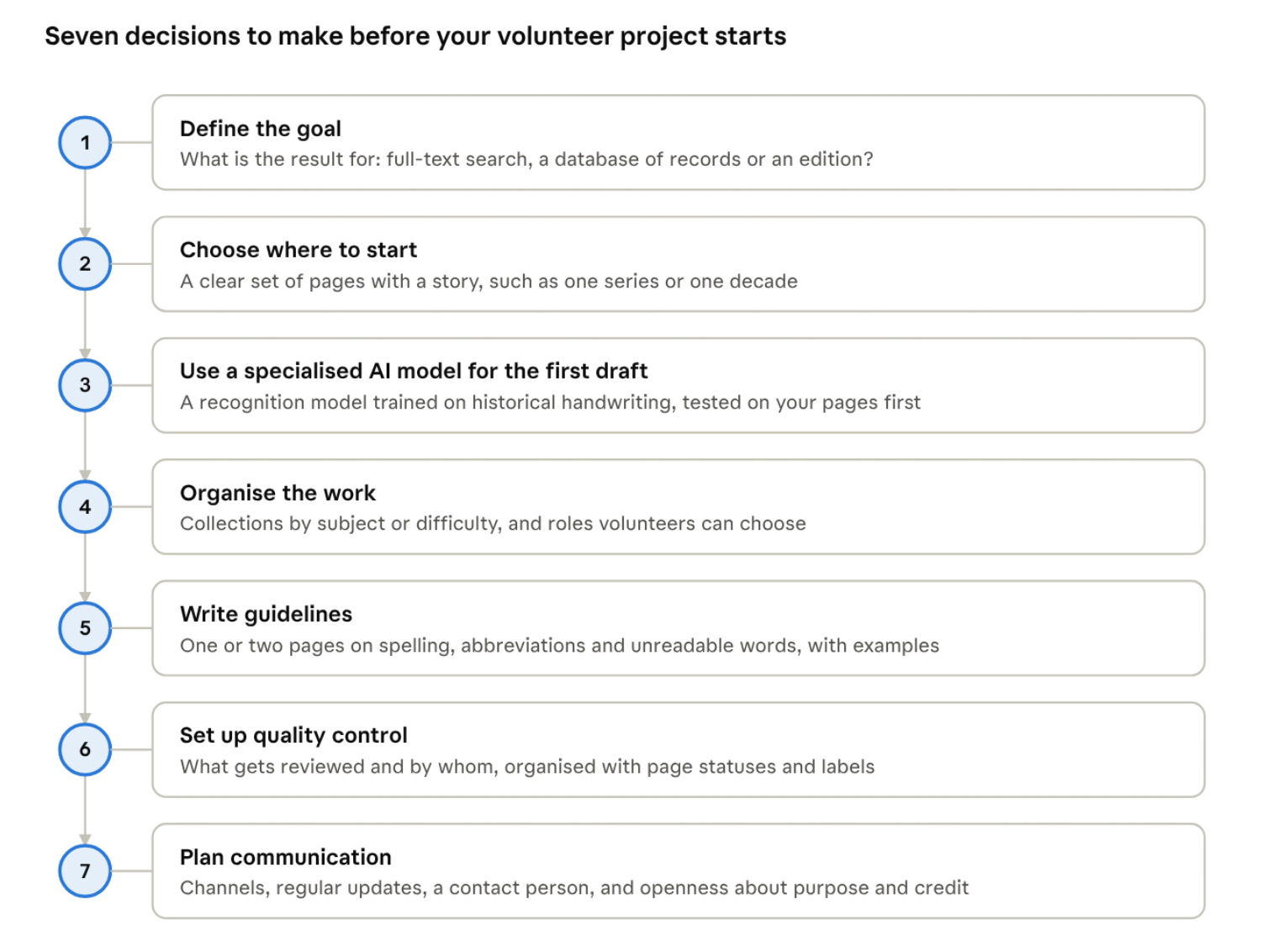
Seven decisions to make before a volunteer project starts.
1. Define the goal of your project
Decide first what the result is for. A searchable collection can live with a few errors, but a database of baptisms needs every name and date right, because a wrong surname makes a record unfindable. The goal sets how much checking you need.
2. Choose where to start in your collection
Start with a clear set of pages that tells a story, such as one series or one decade, and leave the most difficult volumes for later. Early, visible progress keeps volunteers motivated.
3. Use automatic text recognition for the first draft
General-purpose chatbots can give good results on many documents, but they are rarely built for historical handwriting. Test a specialised public model on a sample of your pages first; if the results are weak, a few carefully transcribed pages are enough to train a model on your own hands. Emily Vine of the wills project also advises making sure someone with technical expertise is part of the team.
Learn more: Choosing a Model and Training your own model
4. Organise the work around your volunteers
Split the material into collections by subject or difficulty, so volunteers only see what they chose, and let them pick a role, from transcribing and proofreading to correcting the layout or tagging names, dates and places. The Museum Plantin-Moretus organises its community exactly this way.
Learn more: Managing Collections or Managing User Rolse
5. Write transcription guidelines for volunteers
One or two pages on spelling, abbreviations, unreadable words and marginal notes are enough. Add a few example pages on how to correct the autimatically transcribed pages and update the guidelines as questions come in.
Learn more: Transcribing Manually
6. Set up quality control
Decide which parts need review, such as all names in a register. In Transkribus, volunteers save finished pages as Done, the project lead reviews them and saves them as Final or Ground Truth, and labels flag pages that are damaged or faded.
Learn more: Managing Documents and Pages
7. Choose how to communicate with your volunteers
Volunteers give their free time and should never feel like unpaid labour. Decide where you will stay in touch, how often you share updates and who answers questions, and be open from the start about why the project exists and how contributors will be credited. The Museum Plantin-Moretus uses Slack, webinars and online tours to keep its community connected.
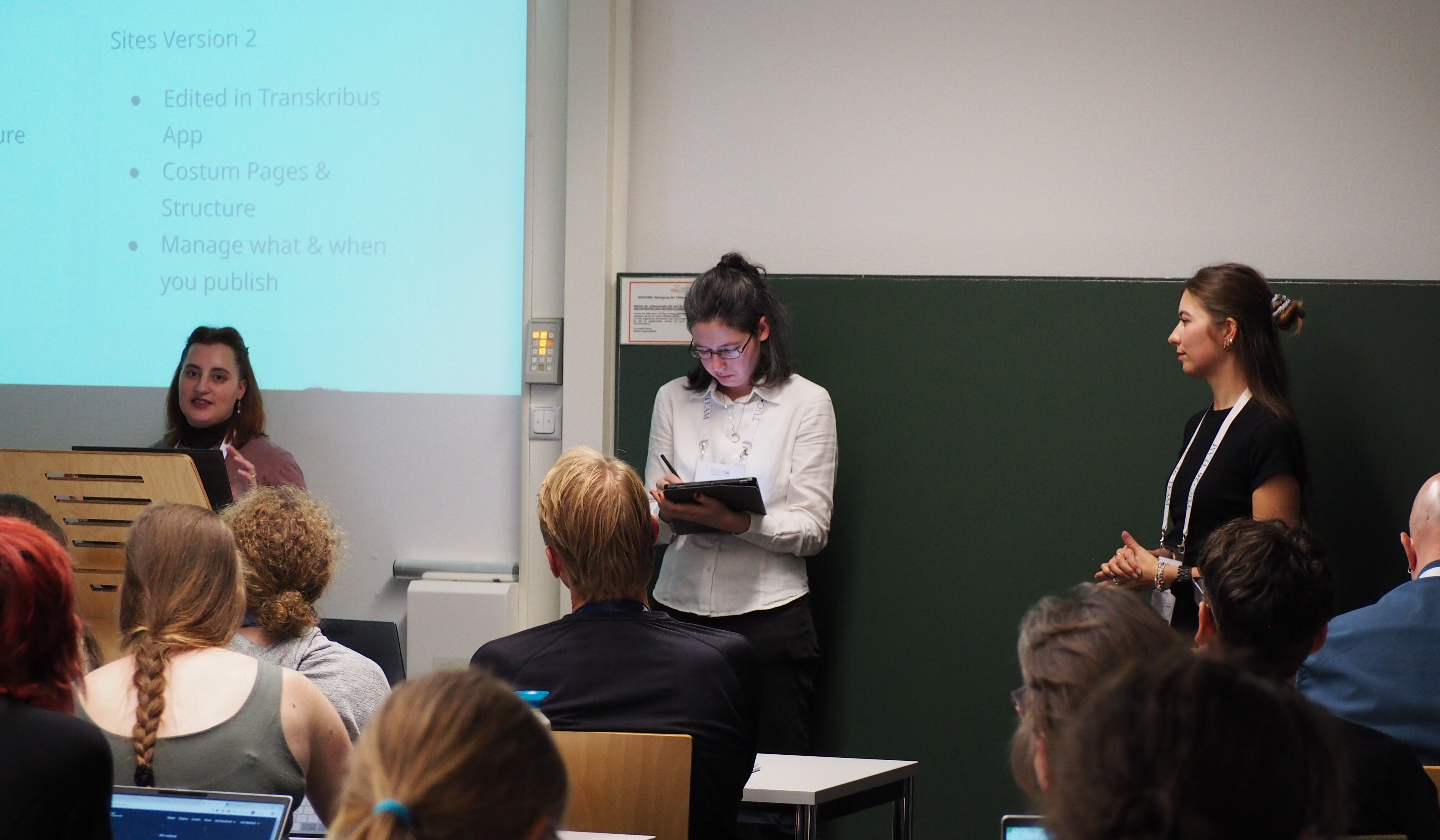
Transkribus Workshop hosted by team members at TUC26. © Transkribus
How to recruit, engage and keep volunteers
Once the project is planned, the focus shifts to the people, from finding volunteers and getting them started to keeping them motivated and closing the project well.
Where to find volunteers
The best volunteers often come from people who already know your collection: reading-room users, genealogists, local history societies, readers of your newsletter. Universities are another source, as students can practise palaeography on real documents.
A wider call can work too. When the Museum Plantin-Moretus launched its project in 2024, a call on social media and a report on local TV brought in 120 applications.
Getting started together
It helps to begin with a short first session, in person or online, where you show the tool, work through one page together and introduce the contact person. The Museum Plantin-Moretus held information sessions on palaeography and transcription before training its first group of around 50 volunteers, and those on the waiting list are now joining in a second wave.
Keeping volunteers motivated
Once volunteers are on board, share progress regularly and, above all, the stories volunteers find, such as an unexpected entry, a family connection or a surprising detail. Credit contributors in the published collection if they agree. In the wills project, volunteers even started writing their own blog posts about the documents.
Not everyone will stay, and that is normal. At the Museum Plantin-Moretus, some volunteers found that palaeography was not for them or that they lacked the time, but a dedicated core formed. Their work helped uncover the stories of the women who lived and worked in the printing house for 200 years, which became an exhibition at the museum.
Watch the full story of how the museum built its volunteer community in Selleslach's talk at the Transkribus User Conference 2026:
Closing a project well
Something that tends to get overlooked is that the end of a project matters as much as the start. The first step is to publish the result where people search, in a format your systems accept. If you don't have a portal of your own, Transkribus Sites lets you publish the transcribed collection directly as a searchable website from within the platform.
Publishing is also the right moment to give something back to the people who made the result possible. Acknowledging the volunteers' contribution publicly, and sharing the stories and discoveries their work has uncovered, shows them what their effort achieved. A community that feels appreciated in this way stays together, returns for the next project and often brings new helpers with it.
Keeping your volunteer project in one place with Transkribus
Transkribus Projects does not replace the planning, recruiting and community work described above, but it makes the part that happens on the platform much easier. Instead of scattered collections and shared links, everything belongs to one dedicated space, including the collections volunteers work on, the recognition models, datasets and published Transkribus Sites.
Inside the Transkribus editor, the comments feature is another useful tool for working with volunteers. Questions about an unclear word, a doubtful reading or a page that needs a second look can be discussed right where they come up, so the project lead and other volunteers see them in context.
Each person gets a role (Owner, Editor, Transcriber or Reader), so volunteers can transcribe without changing your setup. A project can stay private or be made public to recruit volunteers, who join automatically or after approval. Projects are included with every Transkribus account at no extra cost, with no limit on members.
A Transkribus project page brings together members, collections, models and published sites in one place. © Transkribus
Getting started with your own volunteer project
A successful volunteer transcription project rests on a few clear decisions made early: what the result is for, where in the collection to begin, how AI and people share the work, and how you will stay in touch with the volunteers who make it possible. Get those right, and the rest grows with the community itself, as the wills project and the Museum Plantin-Moretus both show. Whether your collection holds a few hundred pages or tens of thousands, the best time to open it up is when you have a first set of pages, a first draft from the machine and a few people who care as much about the material as you do.
Start a project in Transkribus and invite your first volunteers.
Related Articles
Charting new waters: How 3 projects opened up maritime archives with AI transcription
Maritime history is a field that explores humanity's relationship with the oceans, seas, and waterways of the world. While ships and naval battles are the focus of some maritime historians, others…
Transkribus for teams: A practical guide
Starting a large historical research project? Trying to digitise and transcribe a whole archive? That’s not a one-person job. Even with the help of powerful tools like Transkribus, the sheer amount…
How the Hanse.Quelle.Lesen! project made Hanseatic records accessible through Citizen Science
The Hanse.Quelle.Lesen! project is a collaboration between the Research Centre for Hanse and Baltic History (FGHO), based at the European Hansemuseum Lübeck, and the Archive of the Hanseatic City of…