AI Made for German: Unlocking German-language archives with Transkribus
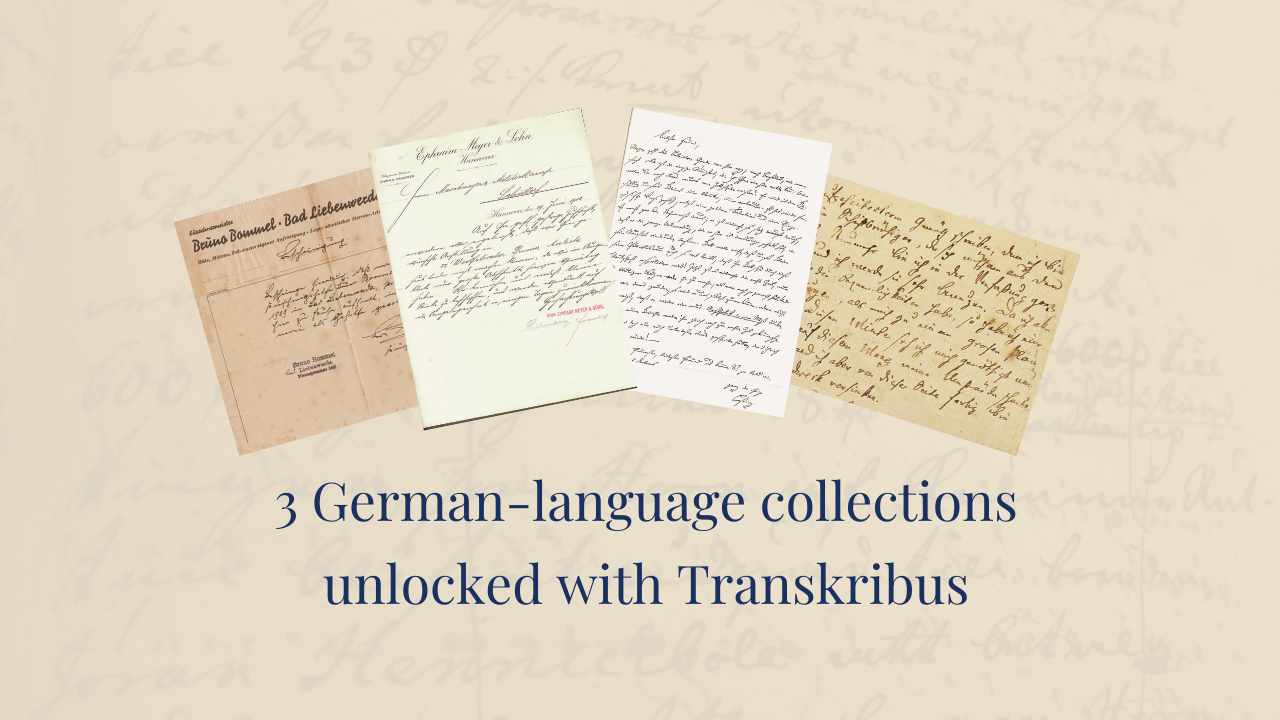
Most AI transcription tools are designed with English-language material as their default setting. They excel at modern printed text and increasingly handle contemporary handwriting, but historical German documents pose a different kind of challenge altogether. Scripts such as Kurrent and Sütterlin demand specialised training, and older print styles like Fraktur introduce additional complexity that many general-purpose models are not equipped to manage.
Transkribus was built with these exact challenges in mind. Originally developed from OCR technology tailored to Fraktur print, it has grown into a sophisticated AI platform capable of handling a wide spectrum of historical scripts. It reads Kurrent and Sütterlin with the same reliability as English Secretary Hand, making it particularly well-suited for German-language and multilingual collections.
To see what this looks like in practice, this post explores three real-world examples. From large-scale institutional projects to independent research, each case shows how Transkribus is being used to transform German-language documents into searchable digital text, opening them up to researchers and audiences around the world.
.png) How the Museum für Naturkunde Berline digitised 250,000 specimen labels
How the Museum für Naturkunde Berline digitised 250,000 specimen labels
At the Museum für Naturkunde Berlin, the challenge is not just complexity, it is scale. The museum holds more than 30 million specimens, each labeled with crucial scientific information. But these labels are often tiny, densely written, and composed in historical handwriting that can challenge even experts, making it difficult for researchers to find and analyse the specimens they need.
Digitising collections such as these requires more than just scanning images. It means transcribing complex handwritten notes to a high degree of accuracy and transforming those transcriptions into structured, searchable data, suitable for a diverse range of research purposes.
With the help of a custom Smart Extract Model developed by the Transkribus team, the museum effectively converted around 250,000 individual labels into a resource that scientists worldwide can search, analyse, and build upon. What was once locked inside drawers is now becoming part of a global research infrastructure.
Find out more about the Museum für Naturkunde project in this blog post.
.png) Preserving everyday voices through citizen science at the German Archives for Diaries
Preserving everyday voices through citizen science at the German Archives for Diaries
Not all collections are built on scale, some are built on human stories. The German Archives for Diaries (Deutsches Tagebucharchiv, DTA) in Emmendingen holds around 27,000 personal diaries, offering rare, unfiltered glimpses into everyday life across generations. But the diversity of handwriting styles and historical periods makes transcription a monumental task.
Rather than tackling this alone, the archive embraced a citizen science approach. With Transkribus, volunteers across the country can contribute remotely, working together to transcribe and digitise these personal records. The platform does not replace human effort, it amplifies it, making collaboration faster and more effective.
While the transcriptions are not publicly published, they are available to researchers, creating a powerful bridge between public participation and academic research. It is a model that shows how technology can bring communities into the heart of archival work.
Find out more about the German Archives for Diaries project in this blog post.
.webp) Making 300 years of history accessible at the National Archives of Latvia
Making 300 years of history accessible at the National Archives of Latvia
Important German-language projects are not only to be found with the German-speaking regions. At the National Archives of Latvia, researcher Mairita Lukianska set out to digitise the Minutes of the Riga City Council, a sprawling German-language collection spanning nearly 300 years and over 263,000 pages. Working independently, she needed a solution that could handle everything from image processing to complex handwriting recognition.
Transkribus provided that all-in-one capability, allowing her to train a custom model tailored to the historical Kurrent script used in the documents. What emerged was more than just a digitised historical record, it was a vivid window into the past.
"The books document significant historical events," Lukianska notes, "but they also show how closely Riga was connected to European trade and communication networks." Alongside major events like Napoleon’s 1812 campaign, she uncovered stories that feel strikingly human and occasionally strange: an Italian traveller causing a stir in 1644 by exhibiting his Siamese twin, or city regulations cracking down on the illegal import of rhubarb, reminding us that history is not just the grand narratives, but the everyday events too.
Find out more about the National Archives of Latvia project in this blog post.
Transforming the future of German-language heritage
These projects demonstrate that the challenges of historical German scripts—from the complexities of Kurrent to the sheer scale of municipal records—are no longer barriers to accessibility. Whether you are managing millions of scientific labels, coordinating a nationwide network of volunteers, or navigating centuries of history as an independent scholar, Transkribus provides the tools to turn fragile physical archives into searchable, dynamic digital assets, no matter which language they are written in. By making these collections readable, we are not just preserving the past; we are ensuring that the unique voices and data found within German-language heritage can actively inform the research of tomorrow.
If you are ready to bring your own German-language collections into the digital age, explore the tools available on the Transkribus website. Alternatively, if you are a municipal archive looking for tailored digitisation solutions, please visit our dedicated page for local archives.
Related Articles
My READ/Transkribus Story: Tobias Hodel
In 2016 I joined the READ project for the state archives of Zurich. Within the large project, I became part of the dissemination working group and responsible for the alignment of more than 100’000...
Unlocking the secrets of the New Spain Fleets with Patricia Murrieta-Flores
Historians of colonial Latin America don’t suffer from a lack of primary sources. Across archives in Europe and the Americas lie millions of pages documenting the colonial maritime routes known as...
How the German Archives for Diaries preserve personal history for future generations
The German Archives for Diaries (Deutsches Tagebucharchiv, DTA) in Emmendingen has one core mission: Collecting and archiving autobiographical records and making them accessible for academic and...