Amsterdam Notary Archives out of the dark
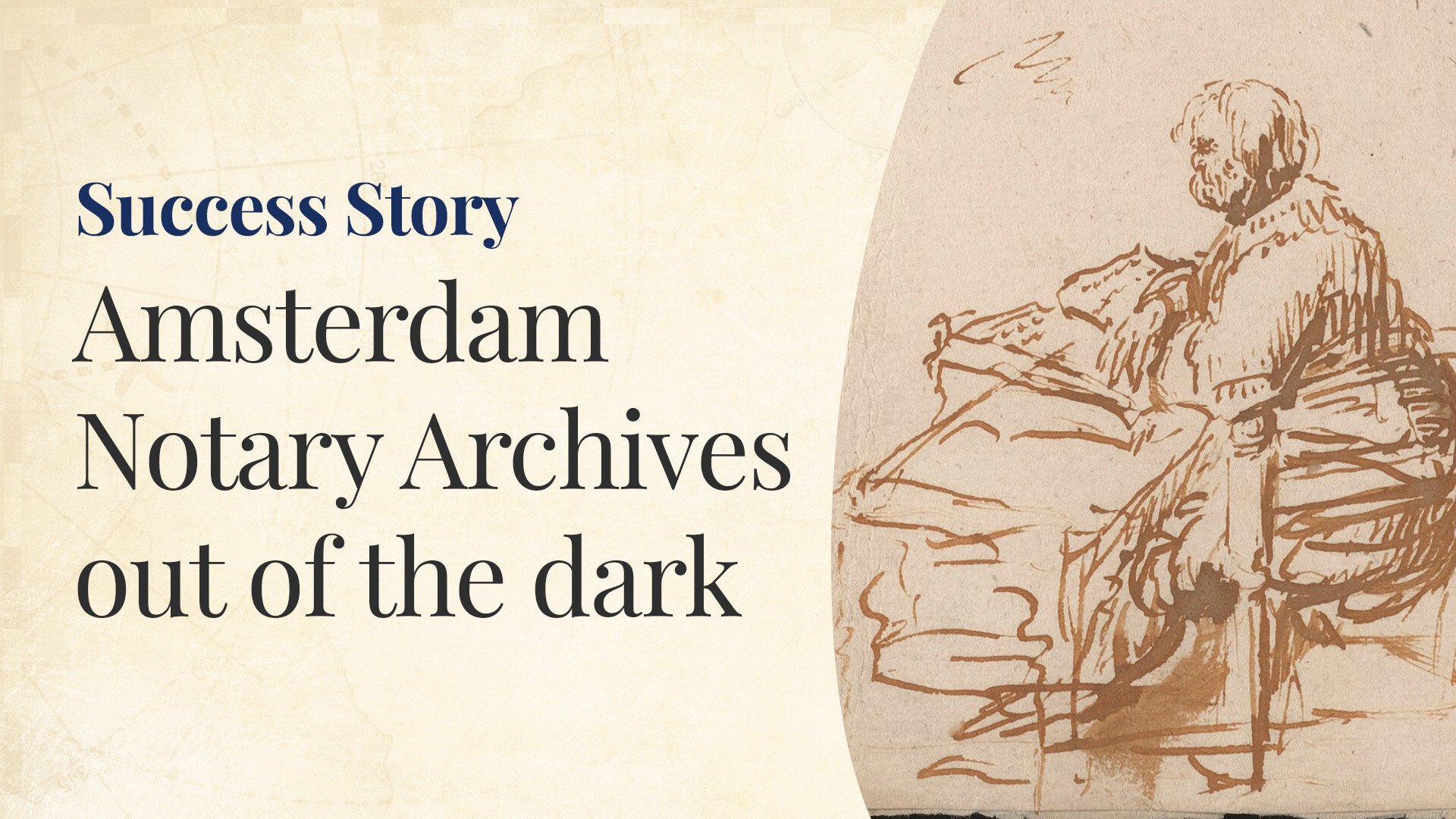
The largest, and richest, collection of documents kept inside the Amsterdam City Archives are no doubt the Notarial Archives, starting from 1578. It spans over 30.000 volumes and after 8,6 millions of scans, digitization is only halfway. Handwritten Text Recognition would be revolutionary in unveiling its content. But would it prove to be useful for such a huge and varied collection, containing documents in all formats, spanning over several centuries, sometimes damaged by fire or water, and, not in the least, written by hundreds of different hands? Transkribus gave us the option to grow and experiment.
The citizen-science project Crowd Leert Computer Lezen on the platform ‘VeleHanden’ combined the powers of the crowd with the HTR tooling of Transkribus. The volunteers provided 10.000 scans of Ground Truth transcriptions in a very short time. We were then able to train notary-specific models (works for selected sets), we combined data in general models (very satisfactory for 18th c. documents) and also combined them with existing basemodels (even better!).
The next step was processing HTR in large quantities and make them available to the public. The first few hundreds of thousands of pages are now searchable thanks to the Transkribus Read&Search interface. Even if the HTR is far from perfect, the advanced search options for fuzzy search with high tolerance reveals many treasures.
As Amsterdam was (and is) an international hub, the HTR results are of interest to scholars worldwide. Within hours, they discovered new details of a mixed and growing population in long-gone neighbourhoods, proof of new global connections, the provenance of numerous european paintings, and even a Surinam-Indian chief was found to be inside an Amsterdam notary office in 1682.
But the most high-profile story to come out of these archives concerns a painting by the famous Dutch artist, Rembrandt van Rijn. For years, scholars have been trying to identify the subject of “Portrait of a Man with Arms Akimbo”, a painting of an unknown gentleman previously thought to be a Dutch sailor or admiral.
However, documents in the Notarial Archives suggest a rather different story. A document from 1663 about the settling of the estate of Amsterdam craftsman Jacob Wesselsz Wiltingh states that “Rembrandt the painter” was paid a sum of money for “painting the deceased”. No further details about this painting or what it looks like are given.
But since the subjects of most Rembrandt paintings are accounted for, many leading scholars now believe that Wiltingh is indeed the “Man with Arms Akimbo”, and the dress and time period would certainly fit.
If you want to find out more about this mysterious Rembrandt painting, you can read the full story here or visit Alle Amsterdamse Akten for more historical stories from this magnificent city.

Related Articles
Transcribing 3 million scans at the National Archives of the Netherlands
Some Transkribus projects are just a few pages long. Many are a few hundred or thousand pages long. But the latest Transkribus project at the National Archives of the Netherlands involved a whopping...

Navigating the transcription of the Dutch Prize Papers
Have you ever sent a letter that never arrived? From 1652-1815 the British navy and privateers seized all types of documents from enemy ships, ship logs, cargo lists and even private letters....
Charting new waters: How 3 projects opened up maritime archives with AI transcription
Maritime history is a field that explores humanity's relationship with the oceans, seas, and waterways of the world. While ships and naval battles are the focus of some maritime historians, others...