achim.rabus · PyLaia · Published October 26, 2022

Russian generic handwriting 2

Text Recognition

Description

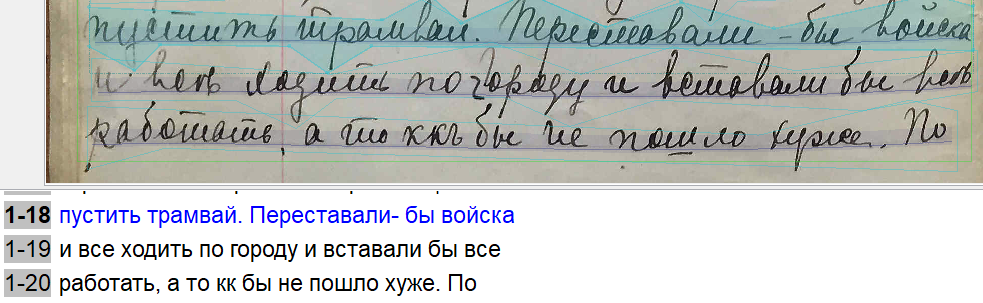
This second version of a generic model for handwritten Russian (predominantly late 19th/early 20th century) was trained as part of the MultiHTR project (Freiburg/Germany, www.multihtr.uni-freiburg.de). It incorporates models trained by the Estonian State Archive and the Hamburg-based INEL project. Portions of the GT data have kindly been provided by the Prozhito project (Saint Petersburg) and the Ukraine RD of JewishGen, USA. In some of the GT transcriptions, pre-1918 letters have been represented faithfully, while in other GT transcriptions, they have been replaced with their modern equivalents. We expanded the first version of the Russian generic model by adding the Russian Civil Records model by IAJGS and the L'Dor V'Dor Foundation's (LDVDF) Documentation of Jewish Records Worldwide (DoJR) project as well as several additional sources from the Prozhito database. Moreover, we incorporated data from the HKR dataset (https://github.com/abdoelsayed2016/HKR_Dataset).

Try this model

Russian generic handwriting 2
Use this modelOpen in Transkribus
Low error rate5.8% CER

Character Error Rate (CER) measures the percentage of characters incorrectly recognised. Lower is better. This model scored 5.8% on its validation set. As a rule of thumb, a CER below 10% is considered good for most handwritten material. This is a larger model trained on diverse material, which generally makes it more robust across different handwriting styles. That said, larger training sets also make it harder to push the CER down further.

Measured on the model's own validation data. Results on your documents may differ depending on handwriting style, document condition, language, and how closely your material resembles the training data.

Words484,429
Lines148,846
Training Pages4,394
Model ID45595
Languages
Russian